The digital economy in Bangladesh is expanding rapidly. With more consumers turning to search engines to find products and services, securing top rankings on search results is critical for business growth. At the core of this online visibility is understanding exactly what your potential customers are typing into their search bars. Professional SEO Services leverage targeted keyword research to connect local businesses with high-intent buyers, driving organic traffic and increasing revenue.
Finding the right search terms requires a strategic approach tailored to the local audience. A generic strategy often falls short because the local market features unique search behaviors, language preferences, and cultural nuances.
This guide will break down how to conduct effective keyword research for the Bangladeshi market, helping you capture valuable local traffic and outperform your competitors.
Understanding the Bangladeshi Market
Before building a keyword list, you must understand how people in Bangladesh search for information online. The market presents a unique blend of linguistic habits and platform preferences that directly impact your strategy.
Unique Linguistic and Cultural Considerations
Search behavior in Bangladesh is highly multilingual. Users typically search using three distinct language formats:
- English: Many professionals and corporate buyers use English for B2B services, software, and international products.
- Bangla (Bengali text): Searching in native Bangla text is growing massively, especially for local news, entertainment, and everyday consumer goods.
- Romanized Bangla (Banglish): Users frequently type Bangla words using the English alphabet. For example, instead of typing “mobile phone price,” someone might search “mobile er dam koto.”
A successful strategy requires optimizing for the specific language format your target audience uses most frequently.
Popular Search Engines and Platforms
Google dominates the search engine market in Bangladesh, handling the vast majority of all search queries. However, social search is also incredibly powerful. Millions of Bangladeshis rely on Facebook search to find local businesses, read reviews, and discover products. While optimizing for Google is the primary goal, integrating social-friendly keywords into your wider content strategy provides a significant advantage.
Step-by-Step Keyword Research Process
Building a robust list of target phrases requires a methodical approach. Follow these steps to uncover the terms that will drive qualified traffic to your website.
Identifying Seed Keywords
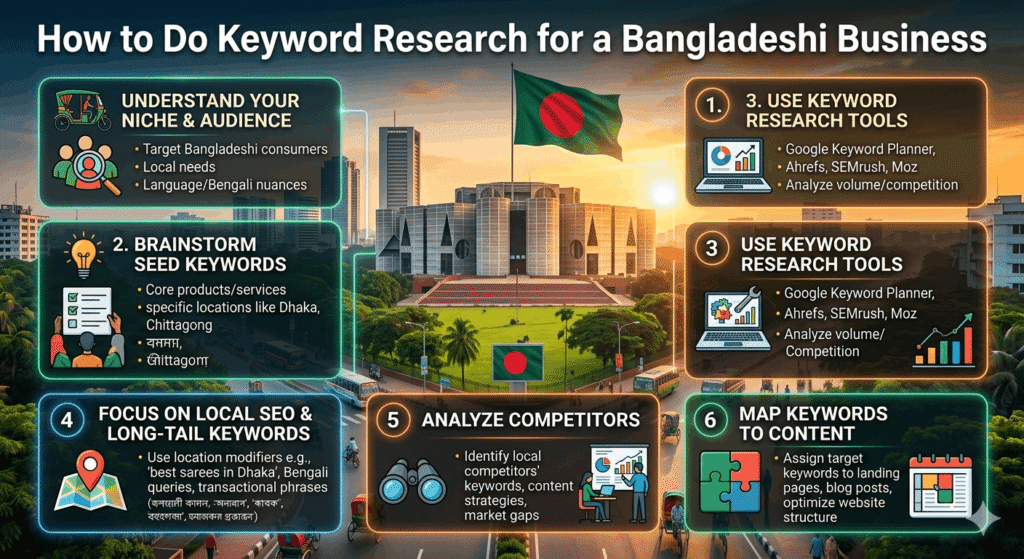
Start by brainstorming seed keywords. These are the broad, foundational terms that describe your core products or services. If you run a clothing brand in Dhaka, your seed keywords might include “panjabi,” “saree,” or “mens clothing.” Think about the exact terms your customers use when describing what you sell, keeping the English, Bangla, and Banglish variations in mind.
Utilizing Keyword Research Tools
Once you have your seed keywords, use research tools to expand your list.
- Free Tools: Google Keyword Planner is excellent for finding search volumes and discovering related terms. Google Trends helps identify seasonal spikes, like increased searches for “sharee” before Eid.
- Paid Options: Tools like Ahrefs and Semrush provide deeper insights into keyword difficulty and backlink requirements. They also help you identify related terms you may have overlooked.
Analyzing Search Volume and Competition
When evaluating potential keywords, balance search volume with competition. High-volume keywords often come with fierce competition from established brands. For a new or growing business in Bangladesh, it is often more strategic to target keywords with moderate search volume and lower difficulty. This allows you to secure page-one rankings much faster.
Long-Tail Keywords for Niche Targeting
Long-tail keywords are longer, more specific phrases. Instead of targeting “shoes,” target “buy leather formal shoes in Dhaka.” Because they are highly specific, long-tail keywords generally have lower search volume. However, the users searching these phrases have a clear intent to purchase, leading to much higher conversion rates.
Local SEO Strategies for Bangladesh
For businesses with physical storefronts or specific service areas, local SEO is the key to driving foot traffic and generating localized leads.
Google Business Profile Optimization
Your Google Business Profile (GBP) is the most critical asset for local search visibility. Claim your profile, ensure your business name, address, and phone number are accurate, and select the correct categories. Include your target local keywords in your business description and regularly update your profile with fresh photos and posts.
Geo-Targeted Keywords
Incorporate city, neighborhood, or district names into your strategy. Users frequently append locations to their searches, such as “best digital marketing agency in Banani” or “dental clinic in Chittagong.” Map these geo-targeted keywords to specific landing pages on your website to capture high-intent local searches.
Local Directories and Citations
Building citations on local business directories reinforces your geographic relevance to search engines. Listing your business on platforms like BDTalika, alongside active participation in relevant Facebook groups and local forums, builds trust and authority. Ensure your contact information remains consistent across all platforms.
Competitor Analysis
Understanding your competition provides a shortcut to SEO success. By analyzing what works for other businesses, you can refine your own strategy.
Identifying Local Competitors
Your SEO competitors are not always your direct business rivals; they are the websites ranking on the first page for your target keywords. Run searches for your primary services and note which local websites consistently appear at the top.
Analyzing Their Keyword Strategies
Use tools like Semrush or Ahrefs to analyze your competitors’ domains. Look at the keywords driving their highest traffic and examine the structure of their top-performing pages. Identify content gaps—topics they have missed or poorly explained—and create superior, more comprehensive content to outrank them.
Implementing and Tracking Keywords
Finding the right keywords is only the first phase. The next step is strategically placing them on your website and monitoring their impact.
On-Page SEO Best Practices
Weave your primary keywords naturally into crucial on-page elements. Ensure your target keyword appears in the:
- Page title and meta description
- H1 headline
- At least one H2 subheading
- The first paragraph of your content
- Image alt text
Avoid keyword stuffing. Search engines prioritize user experience and readability, so your content must flow naturally while providing genuine value to the reader.
Monitoring Keyword Performance and Making Adjustments
SEO is an ongoing process. Use Google Search Console and Google Analytics to monitor your website’s performance. Track which keywords are generating impressions, driving clicks, and leading to conversions. If a specific page is stuck on the second page of search results, review the content, update the information, and try acquiring new local backlinks to boost its authority.
Navigating the Future of SEO in Bangladesh
Keyword research is the blueprint for digital visibility. By understanding the unique linguistic landscape of Bangladesh, targeting specific local intents, and keeping a close eye on competitor movements, you can build a sustainable organic marketing engine.
As search engines evolve to prioritize conversational AI and generative answers, building authority and answering direct consumer queries will become even more critical. Start implementing these research strategies today, continuously refine your content based on performance data, and position your brand as the leading authority in your local market.